
US actors’ union SAG-AFTRA has struck a “tentative deal” with Hollywood studios to end their long-running strike.
The union has been on strike for 118 days, causing major disruption to Hollywood productions in the US and in key filmmaking hubs such as the UK.
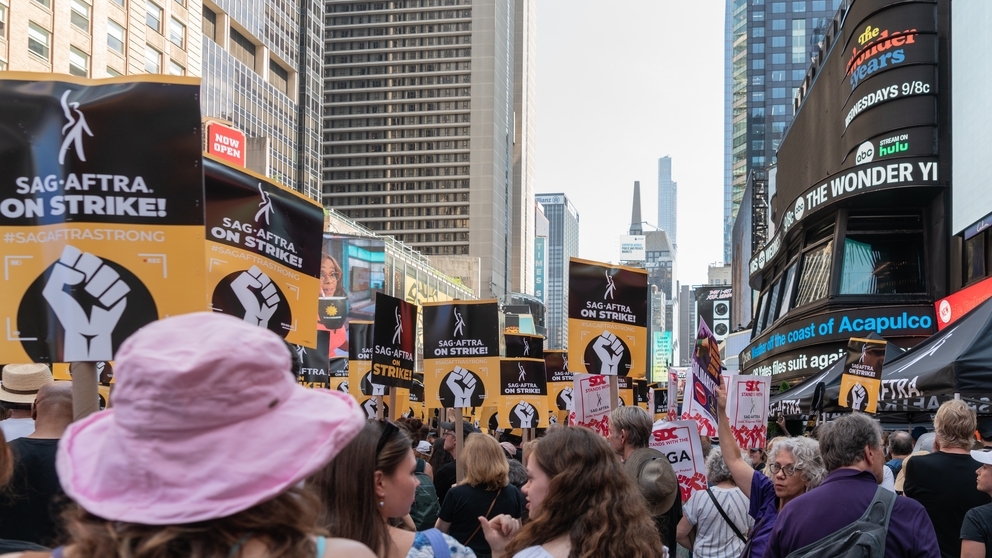
“We have arrived at a contract that will enable SAG-AFTRA members from every category to build sustainable careers,” the union said. “Many thousands of performers now and into the future will benefit from this work.”
The tentative deal will go to the SAG-AFTRA national board on Friday “for review and consideration”, the union announced.
The union said it had agreed a deal of “extraordinary scope” in a contract “valued at over one billion dollars”, including protection from the threat of artificial intelligence and “unprecedented provisions for consent and compensation”.
The Association of Motion Picture and Television Producers (AMPTP), which represents the studios and major streamers, said the tentative agreement “represents a new paradigm”.
The AMPTP said: “It gives SAG-AFTRA the biggest contract-on-contract gains in the history of the union, including the largest increase in minimum wages in the last 40 years; a brand new residual for streaming programmes; extensive consent and compensation protections in the use of artificial intelligence; and sizeable contract increases on items across the board.”
The deal was welcomed by the UK production sector which has been hard hit by the strikes.
Responding to the tentative agreement between SAG-AFTRA and the AMPTP, Adrian Wootton, CEO of the British Film Commission, said: “Today’s news will bring relief to cast, crews and the wider industry on both sides of the Atlantic. We’re thrilled that an equitable agreement on such a complex set of issues was achieved, and we look forward to productions in the UK restarting as soon as possible, assuming the final vote on Friday ratifies the deal. We also want to recognise that this has been an extremely challenging time for many in the UK production community, so this agreement provides a welcome end to a tough period.”
You are not signed in
Only registered users can comment on this article.

Sunderland’s Crown Works studio moves closer to construction
The final details for construction of a major TV and film studio in Sunderland have been set out in a revised application submitted to the city's planning authority.

World broadcasters meet to prepare for 2028 Olympics and Paralympics
Olympic Broadcasting Services (OBS) has briefed broadcasters on production and technology preparations for the 2028 Olympic and Paralympic Games (LA28).
.jpg)
Paramount and WBD pause merger after legal challenges
Paramount Skydance and Warner Bros. Discovery are to delay their $110bn merger due to pending lawsuits from US states and the Writers Guild of America.

Mediaproxy partners with HVS for US broadcast market
Mediaproxy has named Heartland Video Systems (HVS) as its exclusive partner for US television broadcasting. The Wisconsin-based systems integrator will represent Mediaproxy’s full range of technologies, including LogServer and Monwall, and offer them as part of its installation portfolio.

Zixi and CTA partner for IP-based distribution
Live video delivery and workflow orchestration specialist Zixi and Comcast Technology Solutions (CTS) have announced a strategic new integration to deliver C-band replacement solutions for linear broadcasters and content distributors.
.jpg)

.jpg)