

European women’s football leagues continue to be undervalued by media owners, despite the growing popularity of the sport, according to an Ampere Analysis report.
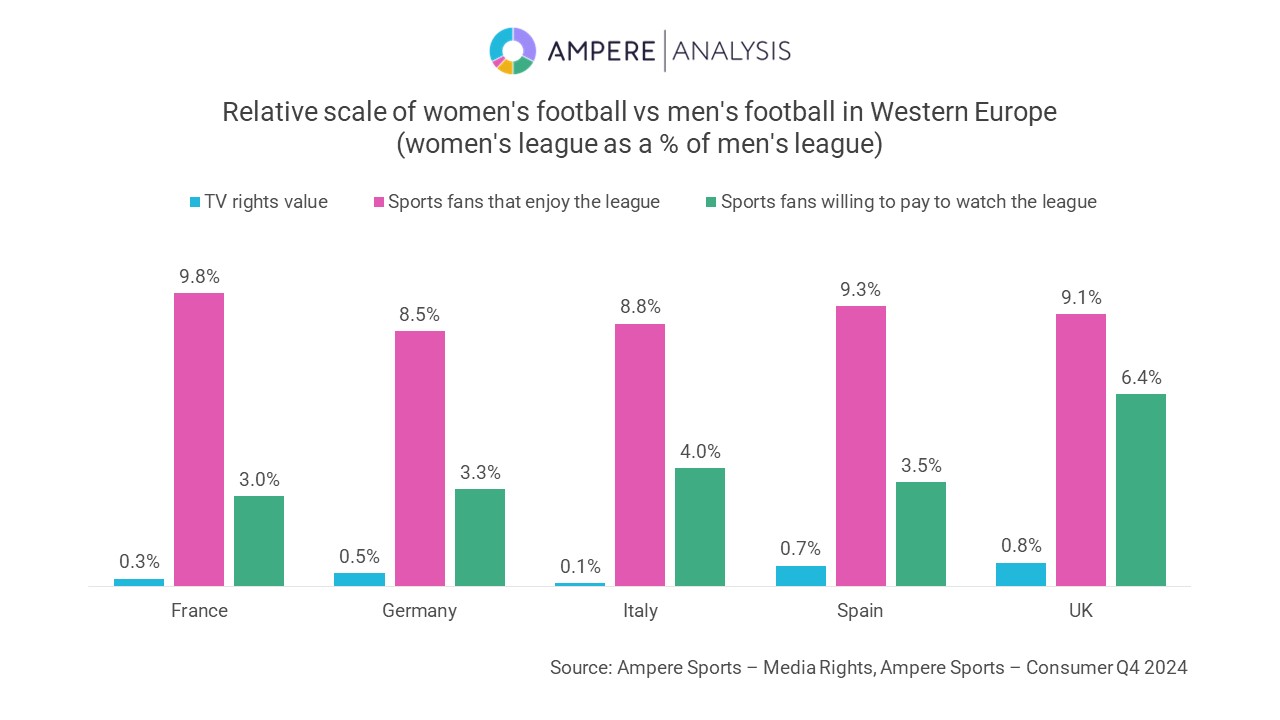
Ampere found that the current rights valuation of European women’s football leagues stands at approximately 0.5% of the value of the men’s leagues.
But rights valuations are likely to increase when the rights are next negotiated given the sport’s popularity with fans and TV audiences.
The Women’s Super League (WSL) has the highest rights value of the five largest domestic European leagues. Its new deal stands at £13m per season, 0.8% of the newest English Premier League deal, worth £1.6bn per season.
In France, the Première Ligue is reported to be worth €1.3m per season, just 0.3% of the €479m value of the men’s Ligue 1 rights.
However, the size of the domestic fanbase for each of the women’s leagues averages at a much larger value, at 9% of the size of the men’s league fanbase.
Part of the gap in rights values is because supporters of the men’s leagues are typically more engaged with the coverage of the leagues. A higher number of men's football fans say they watch all or most of the competition.
Similarly, a higher proportion of supporters are willing to pay to watch men’s leagues than women’s. In each of the five markets, the men’s football league is the top competition that followers say they will pay for. Between 19% and 41% of sports fans are willing to pay for the men's event, versus only 1% to 3% for the women’s leagues.
However, the willing-to-pay fanbase for women’s leagues is still 3-6% the size of that for the men’s leagues. This is a higher proportion than the gap in rights valuations suggests. Therefore, while media rights values for women’s leagues are starting from a lower point, Ampere believes they have an opportunity to grow further.
Danni Moore, Senior Analyst at Ampere Analysis said: “Ampere’s analysis indicates that the recent scaling of women's fan bases should drive upside for rights owners in the next round of negotiations. Growing audiences and increasing willingness to pay for access among supporters are likely to support increased deal values in the future, closing the gap a little between the men's and women's games. The lack of historic precedent, however, means that women's competitions will have to work hard to prove this value to prospective rights buyers.”
You are not signed in
Only registered users can comment on this article.
.jpg)
Expanded Future Tech to showcase the very best in innovation, technology and talent
After a successful debut in 2025, Future Tech returns to Hall 14 of the RAI this year, with more features, more innovation and more of the technologies shaping the next era of media and entertainment.
.jpg)
UK TV industry advocates out-of-hours guidelines
The UK television industry has backed new guidelines to minimise out-of-hours contact to help improve work-life balance in the sector.
.jpg)
EU approves Paramount's WBD acquisition with conditions
The European Commission has approved Paramount Skydance’s proposed $110bn acquisition of Warner Bros. Discovery.

Isabel Davis to become Director of BFI Filmmaking Funds
The British Film Institute (BFI) has named Isabel Davis as Director of its BFI National Lottery Filmmaking Funds.

Netflix uses GenAI on 300 titles in 2026
Netflix has revealed that nearly 300 titles on its platform have used generative AI, from early concept stages and pre-visualisation through to post-production and release.