The European Broadcasting Union (EBU) and Nvidia have partnered to create sovereign AI and cloud technologies for public service media.
Nvidia’s collaboration with the EBU focuses on helping build sovereign AI and cloud frameworks for the EBU, whose 110 members include the BBC, France Télévisions, Italy’s RAI and Germany’s ZDF.
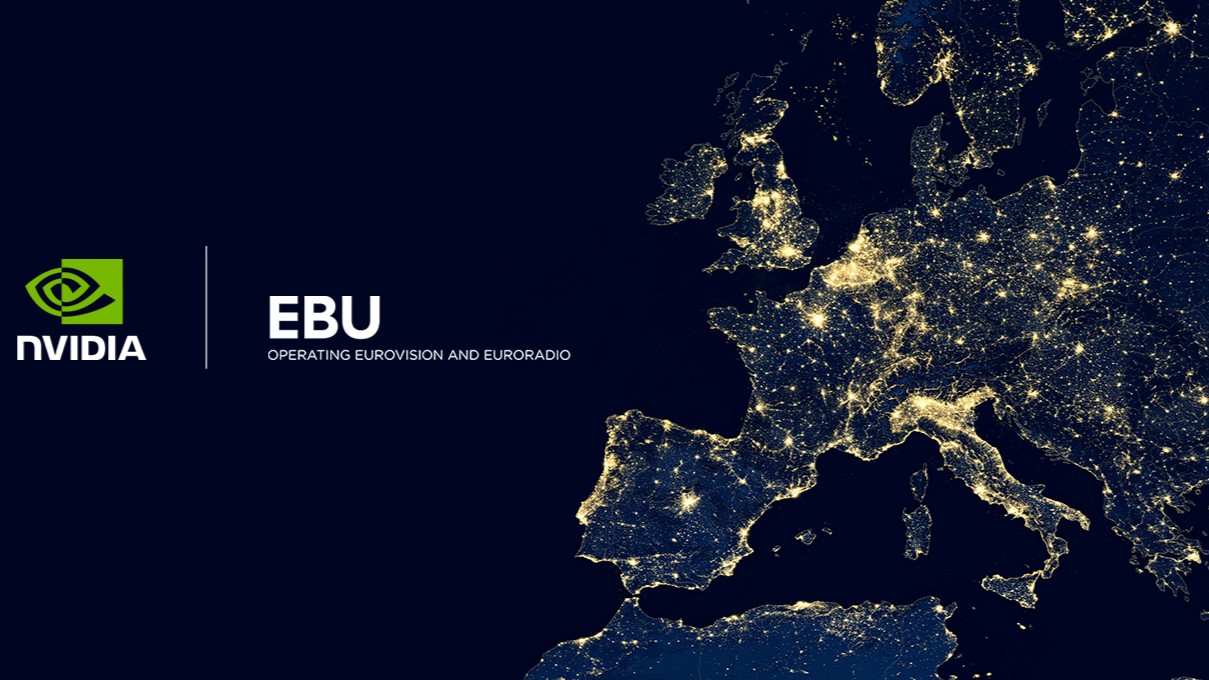
The partnership aims to develop cloud infrastructure and AI services that are governed by European policy, comply with European data protection and privacy rules, and embody European values.
Sovereign AI ensures nations can develop and deploy artificial intelligence using local infrastructure, datasets and expertise.
The partnership comes after the EBU’s Technical Assembly last week called for the development of ‘sovereign, interoperable, resilient, and sustainable’ cloud and AI infrastructure to support public service media across Europe.
“We are proud to collaborate with Nvidia to drive the development of sovereign AI and cloud services,” said Michael Eberhard, Chief Technology Officer of public broadcaster ARD/SWR, and Chair of the EBU Technical Committee. “By advancing these capabilities together, we’re helping ensure that powerful, compliant and accessible media services are made available to all EBU members — powering innovation, resilience and strategic autonomy across the board.”
Nvidia and the EBU plan to develop hybrid cloud architectures that meet the standards of European public service media. The EBU will contribute its Dynamic Media Facility (DMF) and Media eXchange Layer (MXL) architecture, aiming to enable interoperability and scalability for workflows, as well as cost- and energy-efficient AI training and inference. Following open-source principles, the work aims to create an accessible, dynamic technology ecosystem.
The collaboration will also provide public service media companies with tools to deliver personalised, contextually relevant services and content recommendation systems, with a focus on transparency, accountability and cultural identity. This will be achieved through investment in sovereign cloud and AI infrastructure and software platforms such as Nvidia AI Enterprise, custom foundation models, large language models trained with local data, and retrieval-augmented generation technologies.
As part of the collaboration, Nvidia is also making available resources from its Deep Learning Institute, offering European media organisations training programmes to create an AI-ready workforce. This will support the EBU’s efforts to help ensure news integrity in the age of AI.
In addition, the EBU and its partners are investing in local data centres and cloud platforms that support sovereign technologies.
“Building sovereign cloud and AI capabilities based on EBU’s Dynamic Media Facility and Media eXchange Layer architecture requires strong cross-industry collaboration,” said Antonio Arcidiacono, Chief Technology and Innovation Officer at the EBU. “By collaborating with Nvidia, as well as a broad ecosystem of media technology partners, we are fostering a shared foundation for trust, innovation and resilience that supports the growth of European media.”
.jpg)
Expanded Future Tech to showcase the very best in innovation, technology and talent
After a successful debut in 2025, Future Tech returns to Hall 14 of the RAI this year, with more features, more innovation and more of the technologies shaping the next era of media and entertainment.
.jpg)
UK TV industry advocates out-of-hours guidelines
The UK television industry has backed new guidelines to minimise out-of-hours contact to help improve work-life balance in the sector.
.jpg)
EU approves Paramount's WBD acquisition with conditions
The European Commission has approved Paramount Skydance’s proposed $110bn acquisition of Warner Bros. Discovery.

Isabel Davis to become Director of BFI Filmmaking Funds
The British Film Institute (BFI) has named Isabel Davis as Director of its BFI National Lottery Filmmaking Funds.
Netflix uses GenAI on 300 titles in 2026
Netflix has revealed that nearly 300 titles on its platform have used generative AI, from early concept stages and pre-visualisation through to post-production and release.