Top six global content providers – Disney, Comcast, Google, Warner Bros. Discovery, Netflix, and Paramount – will invest a combined $126bn in content this year.
According to research by Ampere Analysis, the spending across these groups will reach a new high in 2024 and account for 51% of the total content spend landscape, up from 47% in 2020.
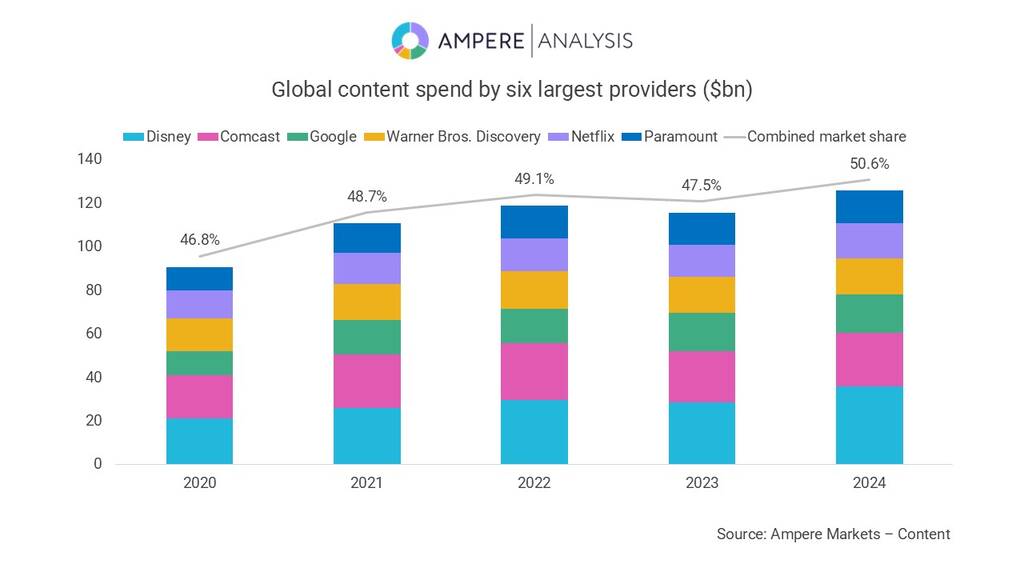
Despite announced cutbacks amongst its linear and theatrical brands, Disney remains the largest contributor to the media landscape at 14% of global investment in TV and film content in 2024. This has been supported by the full acquisition of Hulu at the beginning of 2024, adding an additional $9bn in to Disney’s spend total.
Original content spend remains the leading spend type across the six providers, accounting for over $56bn in investment and 45% of their total spending since 2022.
Google’s contribution to the content market comes via YouTube, and investment in programming through its revenue-sharing arrangements with content creators. YouTube continues to build its global presence through partnership deals with major content owners, making it the third largest contributor to the content landscape.
Netflix is the top investor in global streaming content, averaging a total of $14.5bn in annual investment in original and acquired programmes since the pandemic. Further growth is expected in 2025 through the acquisition of Sports Rights for NFL matches and WWE entertainment.
In total, $40bn of the $126bn is currently spent on these six operators’ subscription streaming services, including Disney+, Peacock, and Paramount+. Ampere said this highlights the growing importance of these platforms as audiences move away from linear television in favour of the convenience and expansive catalogues available via streaming.
Peter Ingram, Research Manager at Ampere Analysis said: “Ongoing investment by major studios and streaming platforms into new programming will continue be key to keeping audiences engaged and entertained. We can expect that the content landscape will see low level growth in 2024 as production schedules recover from disruptions caused by the pandemic and the writers’ and actors’ union strikes. Looking forward however, while these top six providers will continue to account for the majority of spend, overall growth will plateau as companies look to refocus their output. This will include limiting commissioning volumes and prioritising strategic investments and profitability to counter the current challenges of the media market.”
You are not signed in
Only registered users can comment on this article.
.jpg)
Expanded Future Tech to showcase the very best in innovation, technology and talent
After a successful debut in 2025, Future Tech returns to Hall 14 of the RAI this year, with more features, more innovation and more of the technologies shaping the next era of media and entertainment.
.jpg)
UK TV industry advocates out-of-hours guidelines
The UK television industry has backed new guidelines to minimise out-of-hours contact to help improve work-life balance in the sector.
.jpg)
EU approves Paramount's WBD acquisition with conditions
The European Commission has approved Paramount Skydance’s proposed $110bn acquisition of Warner Bros. Discovery.

Isabel Davis to become Director of BFI Filmmaking Funds
The British Film Institute (BFI) has named Isabel Davis as Director of its BFI National Lottery Filmmaking Funds.

Netflix uses GenAI on 300 titles in 2026
Netflix has revealed that nearly 300 titles on its platform have used generative AI, from early concept stages and pre-visualisation through to post-production and release.